iDevices Switch Review: Two Still Running After a Decade
Some links are affiliate links. We only recommend gear we've tested; buying through them supports the lab at no cost to you.
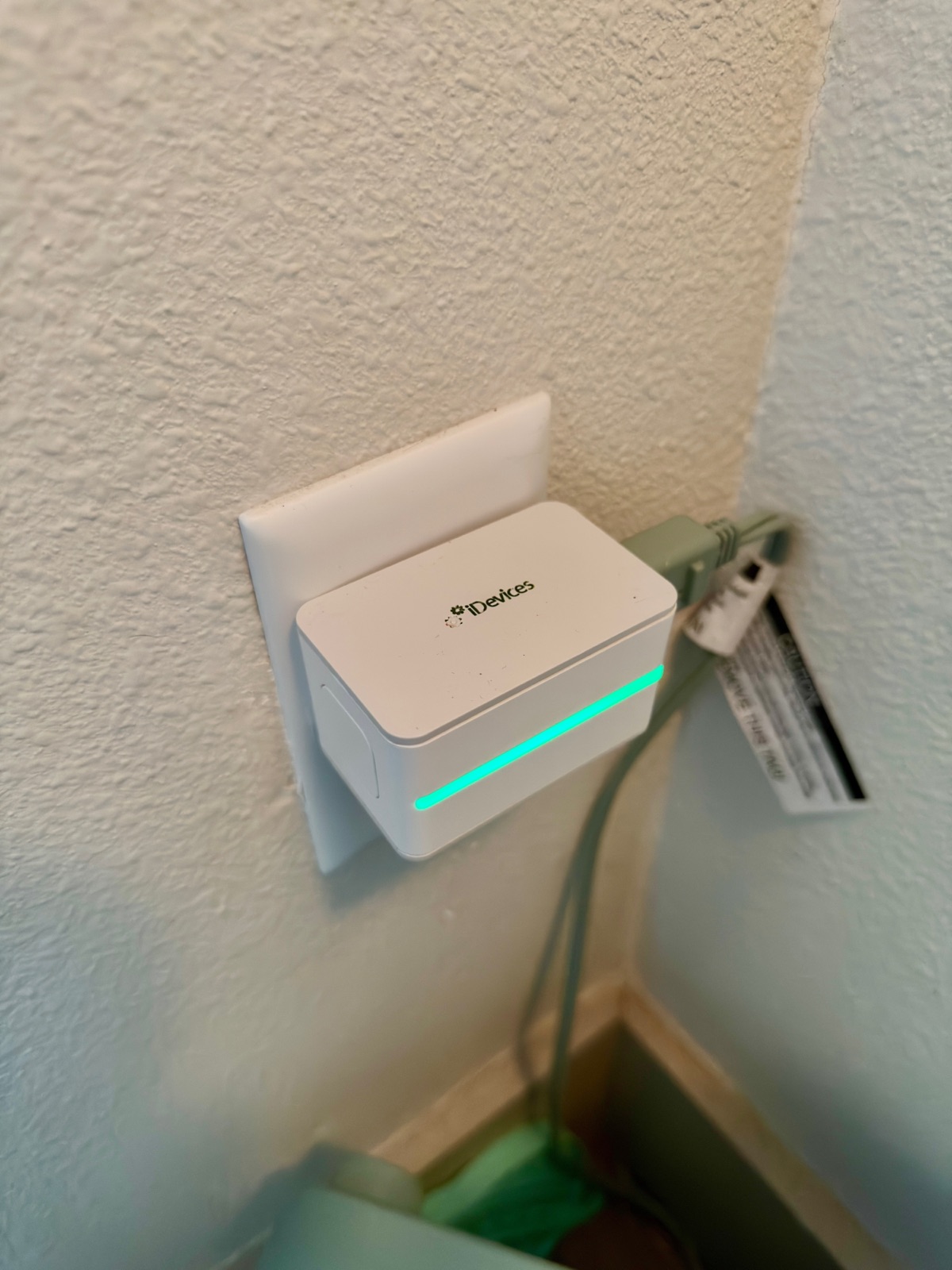
iDevices Switch smart plugs, first bought direct in 2016 and more from Amazon in 2017, are still running daily in Apple Home in 2026, through a corporate acquisition, an app that stopped updating in January 2023, and firmware frozen at 1.9.11. They still work because HomeKit pairing is local and doesn't need the vendor. The side-facing outlet is the design detail that aged best. The built-in night light is the part that aged worst, and it confuses Siri.
Ten years ago this month I posted a six-minute review of the iDevices Switch to my YouTube channel. I’ve bought at least three of them since, and two are plugged in right now. One of them turned on a light in my bedroom about an hour ago.
iDevicesSwitch | A Quick Review, August 13, 2016
These plugs have outlived the company that made them, the app that configured them, and the protocol version they speak. They keep working anyway, and the reason says something useful about how you should buy smart home gear.
What happened to iDevices
On April 25, 2017, Hubbell Incorporated, a large electrical manufacturer, announced it had acquired iDevices. The press release said the usual things about driving the next wave of innovation.
I was already using one when that was announced. My first came direct from iDevices in 2016, which is the unit in the video above, eight months before the acquisition. I bought more from Amazon afterwards, on July 11 and August 27, 2017, so I was still buying them months after Hubbell took over. At least three over the years, probably more.
That’s the useful detail. The acquisition changed nothing visible at the time. The product was on shelves, well reviewed, and I kept buying it. Whatever happened to iDevices happened quietly and later.
What followed was quieter. As an owner, my read is that development on these plugs stopped around 2019. No meaningful new firmware. No new features. No sign anyone was still working on them. The iDevices Connected app limped on a while longer, and now sits at version 4.1.18, last updated January 30, 2023, with a release note reading “Bug fixes and performance improvements.” It still only requires iOS 10.
I could not find a formal end-of-life announcement. Nobody emailed to say the lights were going out. Support simply stopped arriving.
The iDevices cloud is the part that did die. I can’t get the company’s own cloud access working any more. If these plugs depended on iDevices’ servers the way most smart home gear depends on its manufacturer, they’d be bricks in my wall.
They aren’t. Both still respond, including when I’m away from home.
Why they still work
HomeKit pairing is local. Once an accessory is paired, the encrypted relationship lives between the accessory and your home’s hubs, on your own network. It doesn’t need the manufacturer’s cloud, app, or continued existence. Switching on that bedroom light never touches a server in someone else’s data centre.
Remote access works the same way, and people get this wrong. When I turn the plug on from the office, the request goes through my own home hub, an Apple TV or HomePod sitting in my house, brokered by Apple. The manufacturer was never in that path. That’s why losing them changed nothing.
You can see the age in the protocol itself. Every other HomeKit accessory in my house advertises HomeKit Accessory Protocol version 1.1. These two advertise 1.0. They’re the only accessories left here still speaking the original version, and Apple Home in 2026 talks to them without complaint. Their configuration number is still 1, meaning neither has had a configuration change since the day I paired it.
That’s the argument for buying local-first gear. A manufacturer going away doesn’t have to take the accessory with it.
What aged best
In my 2016 review I read the feature list off the box. Two of the bullets were “Side-Facing Outlet” and “Discrete and Compact Design.” Marketing copy. I didn’t think much of it.
It turned out to be the best thing about this plug, and I only know that because I now own the alternative. Three Meross MSS110 plugs run in the same house. The Meross units stand proud of the wall, socket facing straight out, so whatever you plug in sticks out further still. The iDevices Switch turns the socket ninety degrees. Plug and cable hug the wall.
Behind a nightstand or a couch, that’s the difference between furniture sitting flush and furniture sitting a few inches out. Ten years on it’s the design decision I’d most want a modern plug to copy, and most of them still don’t.
What aged worst
The Switch has a built-in multicolour LED night light. It sounded good on the box. In a decade of ownership I’ve never once found it useful. Too dim and too oddly placed to light anything, too visible to ignore. A kitschy novelty.
It’s worse than useless because of how it’s exposed to HomeKit. The accessory presents two separate services under one accessory: the switched outlet, and the night light. Both are controllable. Both read as light-adjacent to Siri.
So when I ask to turn off a light, HomeKit sometimes picks wrong and toggles the night light. The thing I wanted off stays on, and a small coloured LED changes state instead. That’s not a misconfiguration at my end. It follows directly from bundling two controllable services into a single accessory, and I’ve disliked it for ten years. Shopping today, a plug that does one thing is a plug Siri can’t get confused about.
Hands-on notes
The review above is dated August 13, 2016, from a unit bought direct from iDevices before Hubbell owned them. More came from Amazon in July and August 2017. At least three in total, and two are still in daily service today.
The one I use most sits in my bedroom running a string of warm Christmas tree lights. Not seasonally. Year-round. They’re my ambient light, and instead of switching on a harsh overhead fixture I turn on the warm string. A boring, every-single-day use case, which is exactly why I can say the switching still works. If it had gone flaky I’d have noticed within a day.
Both still respond in Apple Home and both still advertise themselves on my network. Neither has needed a re-pair, a factory reset, or a power cycle that I can remember. Their accessory names in Home are both still “Christmas Tree,” which tells you how long ago I set them up and how little I’ve touched them since.
The night light problem is the only recurring annoyance, and it happens often enough that I notice it most weeks.
Should you buy one today?
No, and mostly you can’t. These are discontinued, and putting decade-old Wi-Fi hardware on your network second-hand is a poor idea regardless of how well mine have aged. Firmware frozen at 1.9.11 means any security issue found from here on is permanent.
That’s the honest asterisk. Still working doesn’t mean still a good idea. I keep running mine because they’re already paired, already on my network, and doing a job well. I wouldn’t go buy more.
I ran their thermostats too
The switches weren’t the only iDevices products I bought. My order history shows two iDevices Wi-Fi thermostats, model IDEV0005, ordered in July and September 2016, one for each zone in the house I lived in then.
They were straightforward to install and unremarkable to use, which is what you want from a thermostat. They stayed with that house when we moved, so I can’t tell you how they’re doing now, only that they gave me no trouble while I had them. The thermostat job here is done by a Meross MTS300.
Four iDevices products, two categories, two houses, and nothing that let me down. That’s the part worth sitting with, because the company still went quiet.
What I’d buy instead
The Meross MSS110HK is the plug I reach for now, and I run three in the same house. It pairs locally over HomeKit, the property that matters most in this whole story, and costs a fraction of what the iDevices Switch did.
It isn’t a straight upgrade. The Meross socket faces straight out, so the plug and cable stand proud of the wall. Behind a nightstand that’s the difference between furniture sitting flush and sitting a few inches out, exactly what the ten-year-old iDevices design got right. You’re trading the side-facing outlet for a current, supported product. For most people that’s the correct trade. Go in knowing what you give up.
Meross also makes the garage controller I’ve run since 2024, if you want a second data point on how their hardware holds up: Meross MSG100 review.
If you want what made these good, a compact plug that doesn’t crowd the outlet, look for a side-facing or low-profile design and pair it locally over Matter or HomeKit rather than through a vendor cloud. That combination bought me ten years. It’s the part of this story worth copying.
Common questions
Do iDevices smart plugs still work in 2026?
Yes. Two iDevices Switch units, first bought in 2016, still run daily in Apple Home in 2026. HomeKit pairing is local, so the plugs keep working even though the iDevices cloud no longer does and firmware has been frozen at 1.9.11 since around 2019.
What happened to iDevices?
Hubbell Incorporated acquired iDevices on April 25, 2017. The iDevices Connected app has not been updated since version 4.1.18 on January 30, 2023, and no formal end-of-life announcement was ever published.
Does HomeKit still work if the manufacturer shuts down?
For locally paired accessories, yes. HomeKit keeps the encrypted pairing between the accessory and your own home hubs. Remote access is brokered by your Apple TV or HomePod, not by the manufacturer, so a vendor going away does not break control.
Where to buy, tested picks
Advertisement. These are affiliate links. We only recommend gear we own and have lived with; buying through them supports the lab at no extra cost to you.